
DISLUNA DESIGN STORY · CONCEPT 04 OF 10
Keys on stone. Coat off. Shoulders down. Stone Bell gives the ordinary act of coming home a clear beginning and a softer ending.

The moment we designed for
Rain is still on the shoulders of the coat. A roll of drawings is tucked under one arm. Keys touch the console, and the day's noise finally loses its grip. The gesture takes seconds, but it tells the body that the outside world can remain outside.
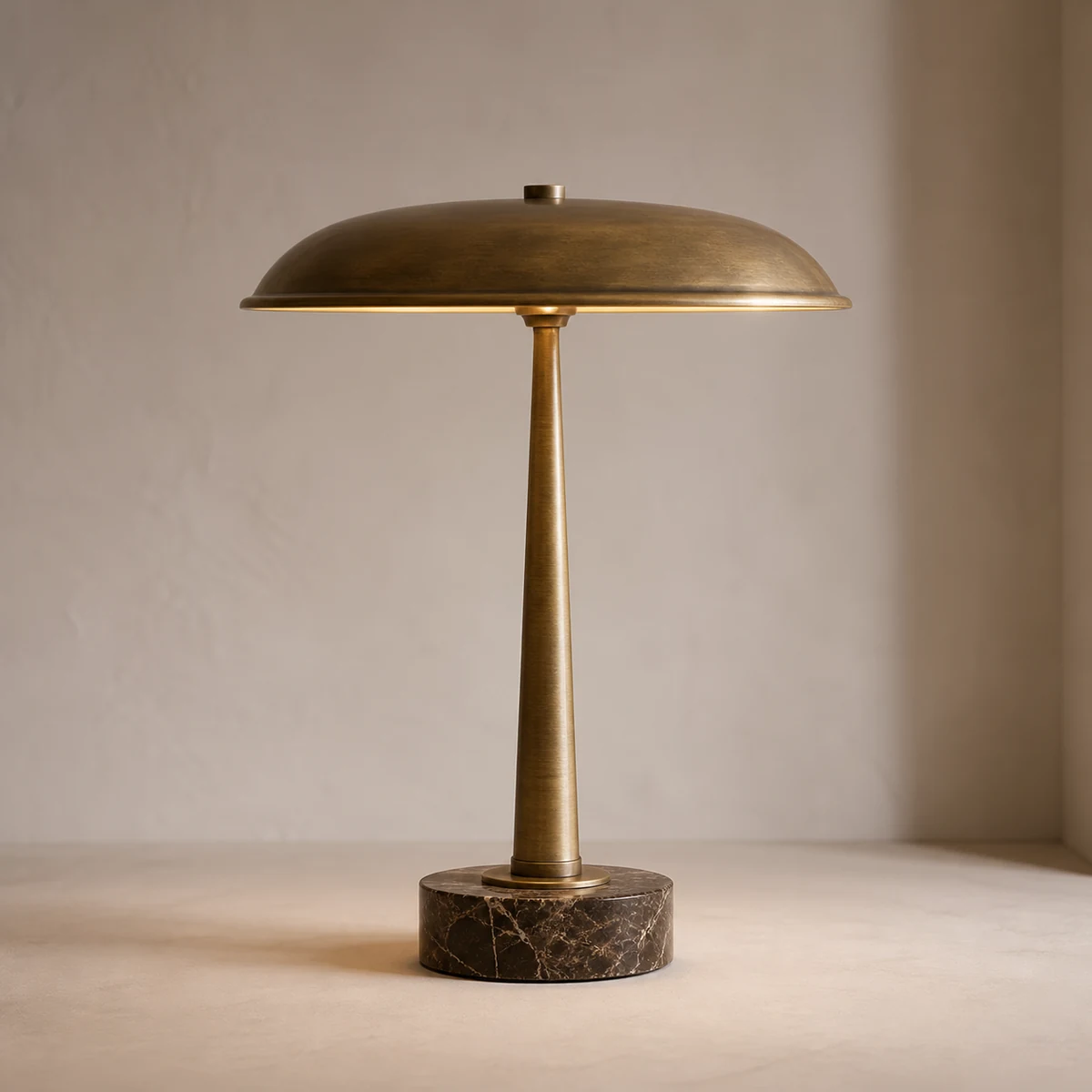
Stone Bell was conceived as a marker for that crossing. The canopy is protective rather than showy; the narrow brass stem lifts it just enough, while a dark stone base gives the hand and eye somewhere solid to land.
The need beneath the object is a boundary. Good entry lighting does not only reveal the way in. It helps a person arrive.
Why the form feels different
A bell-like shade usually suggests softness and symmetry. Here, the material contrast changes the reading: warm metal above, mineral weight below. The base is not a decorative coaster. It is the visual reason the thin stem can feel composed.
Natural-looking stone variation can make every piece feel individual, but it also demands disciplined selection. The design works when the base is expressive at close range and quiet from across the room.
How to place it
Use Stone Bell on an entry console, a hotel check-in side surface, or a bedside table where a small object needs to feel anchored. The stone should sit on a stable, level surface, and the canopy should remain below the primary eye line.
It pairs well with dark wood, limewash, wool, leather, and aged metal. A shallow bowl or one ceramic vessel is enough; crowded styling weakens the base material's role.
A buyer's guide to the first sample
Specify the stone direction carefully: natural stone, engineered stone, or a mineral-effect alternative each changes weight, variation, cost, and packing. Review edge profiles, underside protection, color range, and how the base is isolated from the metal stem.
Final dimensions, weight, output, color temperature, diffuser, controls, power platform, finish, compliance, and packaging remain subject to engineering and sample approval. Stone variation must be defined with an acceptable range, not promised from one visualization.
The promise is not that this concept is already resolved. The promise is that the reason for the design is clear enough to guide every decision that follows.
Questions buyers ask
Is the stone base material confirmed?
No. The image expresses a mineral base direction. Material, weight, color range, edge treatment, and cost must be selected during development.
Where is Stone Bell most useful?
Entry consoles, hospitality arrival points, bedside surfaces, and other locations that benefit from a compact, visually anchored light.
How should natural variation be handled?
Approve a range board or boundary samples so buyers and production teams share the same expectation.
What details are needed for sampling?
Market, use case, quantity, timeline, base material direction, metal finish, power method, controls, and packing channel.
Continue the series with the previous design story or the next design story. Browse more DISLUNA buyer guides and design stories.
Develop this direction with DISLUNA
Share the destination market, project type, quantity, required date, preferred finish, wired or rechargeable direction, control method, and packaging channel. We will confirm the specification questions and a practical sampling route.