
DISLUNA DESIGN STORY · CONCEPT 08 OF 10
Some objects become ours only after our hands have changed them. Saddle Collar brings that sense of touch and memory to a composed, material-led lamp.

The moment we designed for
A family notebook comes apart at the spine after years of being opened on the same recipes. Repairing it is not efficient. That is precisely why it matters. Thread is pulled through old paper, the cover is pressed flat, and an ordinary object is given back to the people who made it meaningful.
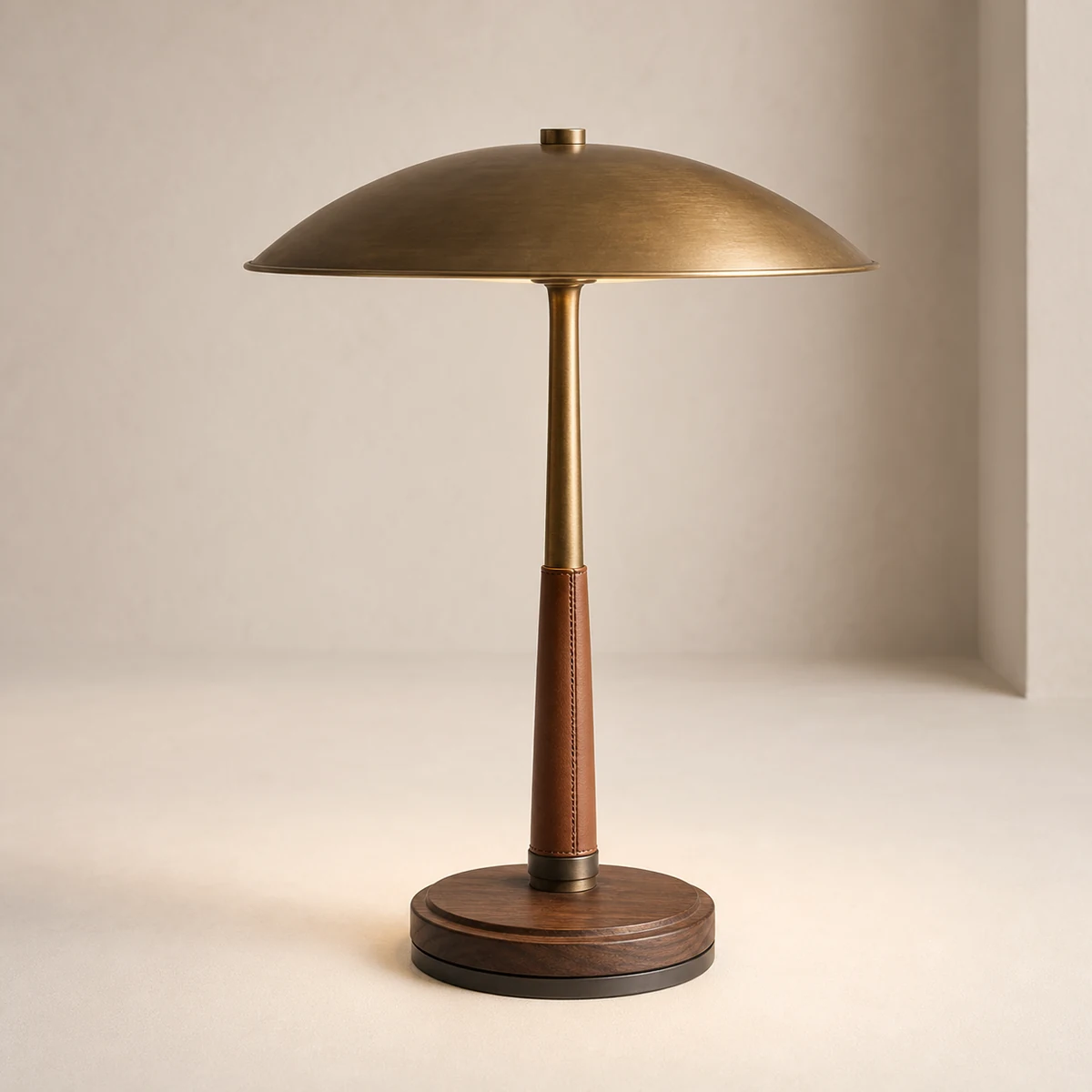
Saddle Collar was designed for this world of contact. The brass canopy provides a calm horizontal line; a leather-wrapped section invites the eye toward the place where a hand might naturally steady the lamp; walnut gives the base warmth and familiarity.
The deeper desire is not nostalgia. It is proof that a useful object can grow more personal instead of more disposable.
Why the form feels different
Three materials carry three roles. Metal reflects and defines. Leather softens the transition through the stem. Wood grounds the object with visible grain. The silhouette remains simple so the material boundaries can be read clearly.
The leather collar should feel integrated, not added as decoration. Its seam, edge finish, thickness, and color relationship to the metal will determine whether the lamp feels crafted or merely accessorized.
How to place it
Saddle Collar suits libraries, private-club lounges, hotel suites, writing desks, and residential side tables. It works best where people can see the material junctions at close range and where the base has room to be touched without being knocked.
Combine it with paper, linen, wool, and dark wood rather than a full set of matching leather accessories. One tactile accent feels intentional; too many can become a theme.
A buyer's guide to the first sample
Specify whether the collar is genuine leather, an alternative material, or another wrapped surface. Consider color variation, seam position, adhesion, abrasion, cleaning, humidity, labeling, and destination-market expectations. Wood species or wood-effect construction also needs a defined grain and color range.
The final size, materials, light source, output, color temperature, dimming, power method, controls, compliance, and packaging are subject to engineering and sample approval. No material claim should be published until the bill of materials is confirmed.
The promise is not that this concept is already resolved. The promise is that the reason for the design is clear enough to guide every decision that follows.
Questions buyers ask
Is the collar confirmed as genuine leather?
No. Leather is the current design direction. The final material and labeling must be agreed for the market and project.
Can the wood tone match a furniture collection?
A target can be developed from a physical control sample, subject to substrate, grain, process, and acceptable variation.
What must be checked on the wrapped stem?
Seam placement, edge finish, thickness, adhesion, abrasion, cleaning behavior, color consistency, and the transition to metal.
Which spaces suit Saddle Collar?
Libraries, private clubs, hotel suites, writing areas, and other close-range settings where material detail matters.
Continue the series with the previous design story or the next design story. Browse more DISLUNA buyer guides and design stories.
Develop this direction with DISLUNA
Share the destination market, project type, quantity, required date, preferred finish, wired or rechargeable direction, control method, and packaging channel. We will confirm the specification questions and a practical sampling route.