
DISLUNA DESIGN STORY · CONCEPT 09 OF 10
Not every useful thought arrives on schedule. Arc Canopy creates a small territory for pausing—open on one side, protected on the other.

The moment we designed for
The drawing is unfinished, but the pencil has stopped. Outside, office windows switch off one by one. For a few minutes there is no deadline to answer and no screen asking for attention. A thought that could not appear during the busy part of the day finally has room to arrive.
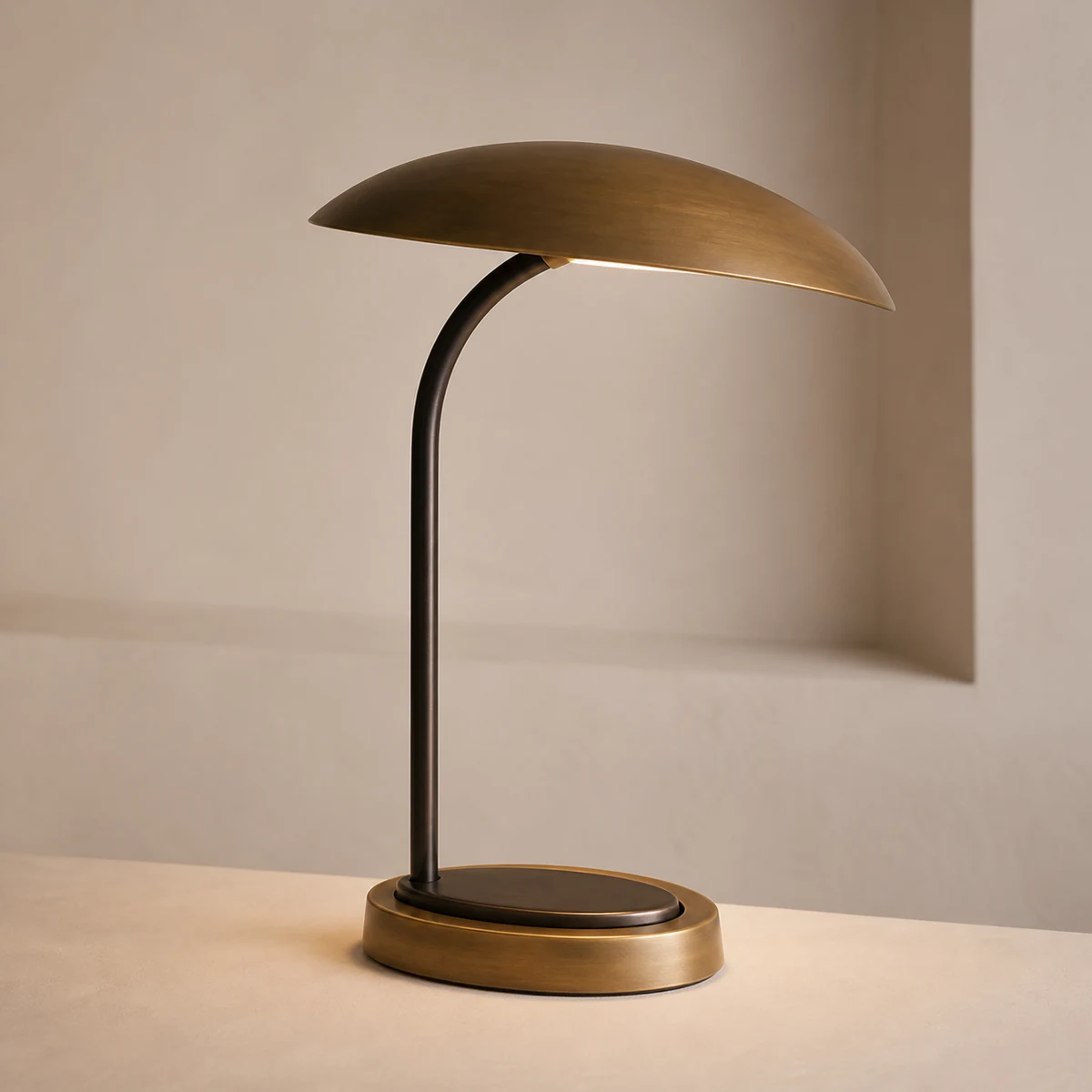
Arc Canopy is shaped around that open pause. A thin curved stem reaches over the table without closing the space beneath it. The oval shade shelters the surface while leaving one side visually free, creating a small territory rather than a rigid workstation.
Its core value is permission to be unproductive long enough to become present again.
Why the form feels different
The asymmetry changes the lamp's relationship to the user. Instead of rising through the center, the stem stands aside and makes room. The canopy appears to hover, held by a line that is structurally expressive but visually light.
This makes proportion especially important. Too heavy a base or thick an arc would remove the tension; too little visual weight could make the form feel unstable. The design depends on a precise balance of reach, clearance, and calm.
How to place it
Use Arc Canopy on a creative desk, a side table beside a chair, a penthouse window ledge, or a quiet hotel lounge corner. Orient the open side toward the user and check that the arc does not conflict with nearby shelving or objects.
The silhouette benefits from a simple wall or window behind it. Keep the surface composition low so the curve can be read in one continuous gesture.
A buyer's guide to the first sample
Sampling should focus on stability, reach, base footprint, stem stiffness, joint quality, and the shade's relationship to the work surface. Test how the lamp is moved and operated; an asymmetric object can experience different loads from a centered lamp.
Final dimensions, materials, output, beam distribution, color temperature, dimming, power architecture, controls, compliance, and packaging are open development items. The concept should not be represented as a certified task light until photometric and market requirements are verified.
The promise is not that this concept is already resolved. The promise is that the reason for the design is clear enough to guide every decision that follows.
Questions buyers ask
Is Arc Canopy a certified task lamp?
No. It is a design concept. Task-light performance can only be stated after the final optical and electrical specification is tested.
Why is the stem offset?
The offset arc opens the center of the surface and turns the illuminated area into a small territory rather than a conventional centered object.
What is critical in the sample?
Stability, reach, stiffness, joint quality, operation, glare, distribution, and how the base behaves when the lamp is moved.
Where can it be specified?
Creative desks, reading side tables, hospitality lounges, and reflective corners with enough clearance for the arc.
Continue the series with the previous design story or the next design story. Browse more DISLUNA buyer guides and design stories.
Develop this direction with DISLUNA
Share the destination market, project type, quantity, required date, preferred finish, wired or rechargeable direction, control method, and packaging channel. We will confirm the specification questions and a practical sampling route.