
DISLUNA DESIGN STORY · CONCEPT 06 OF 10
Children rarely remember the fixture. They remember the pool of light, the last page, and the person who stayed until the room felt safe.
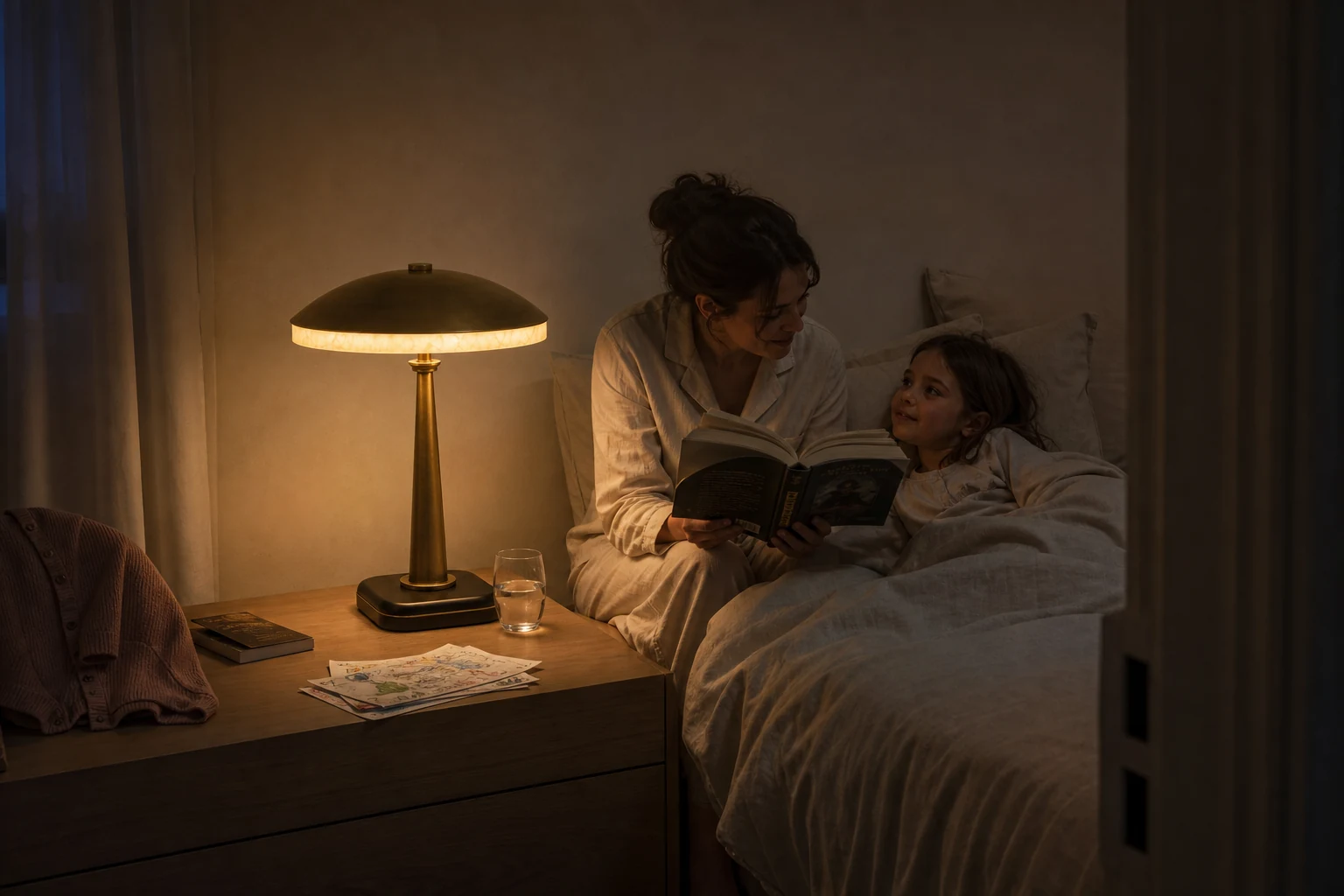
The moment we designed for
The last page is never really the last page. A child asks one more question, then another. The adult lowers their voice. The room outside the pool of light becomes less important, and bedtime changes from a rule into a shared place.
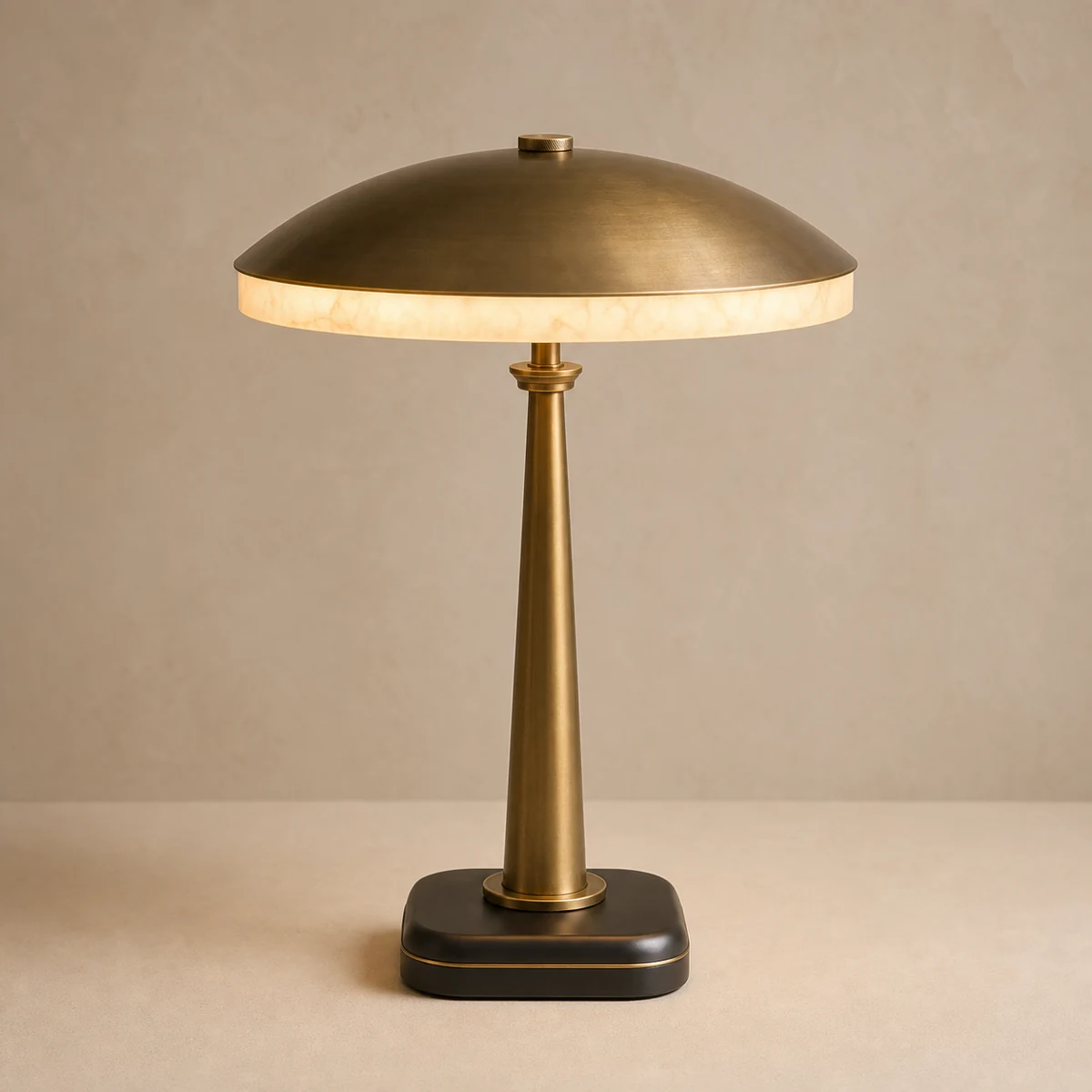
Alabaster Halo was conceived for that held moment. A luminous stone-like band sits beneath the dark canopy, softening the transition between source and shadow. The ring gives the eye a warm boundary without exposing a hard point of light.
What people carry forward is not the object alone. It is the memory of feeling safe enough to stop watching the door.
Why the form feels different
The central gesture is the halo: a translucent-looking layer held between a dark upper shade and a slim brass stem. This makes the light itself part of the silhouette, rather than something hidden inside a metal cap.
The stepped base repeats the ring at a lower, darker frequency, giving the lamp balance. The result can feel quietly ceremonial without becoming precious or theatrical.
How to place it
Use the concept on bedside tables, in family hotel suites, reading corners, or wellness-oriented guest rooms. The final sample should be tested from lying, seated, and standing eye levels; comfortable bedroom lighting depends on the angle of view, not only the measured output.
Allow the luminous ring to be visible against a calm wall. Soft linen, dark timber, brushed metal, and matte paint will support it without creating distracting reflections.
A buyer's guide to the first sample
The stone-like ring could lead to several material routes, each with different weight, diffusion, uniformity, cost, and durability. It should not be described as natural alabaster until the material is selected and documented.
Final material, dimensions, light source, output, color temperature, dimming curve, power method, thermal design, controls, destination compliance, and packaging all require engineering and sample approval. For family settings, the intended user and placement should be stated clearly during development.
The promise is not that this concept is already resolved. The promise is that the reason for the design is clear enough to guide every decision that follows.
Questions buyers ask
Is the luminous ring confirmed as natural alabaster?
No. Alabaster describes the visual direction. The final stone, composite, glass, or diffuser material must be selected and verified.
Can it be used as a reading lamp?
That depends on final output, distribution, placement, and eye-level testing. The concept is currently positioned as a warm bedside layer.
What should a hotel buyer test?
Glare from multiple eye levels, control intuitiveness, cleanability, stability, light uniformity, finish durability, and replacement or charging routines.
What starts a private-label sample?
Provide the market, room type, quantity, required date, material preference, power and dimming needs, and packaging expectations.
Continue the series with the previous design story or the next design story. Browse more DISLUNA buyer guides and design stories.
Develop this direction with DISLUNA
Share the destination market, project type, quantity, required date, preferred finish, wired or rechargeable direction, control method, and packaging channel. We will confirm the specification questions and a practical sampling route.