
DISLUNA DESIGN STORY · CONCEPT 01 OF 10
Before a room welcomes anyone else, it has to welcome the person who lives there. Halo Rib turns that overlooked pause into a small ritual of arrival.

The moment we designed for
There is an hour before guests arrive when a home belongs completely to its owner. A record is chosen. A jacket is put away. The bowl by the door is cleared without hurry. Nothing looks dramatic from the outside, yet the room is changing from a place passed through into a place ready to receive.
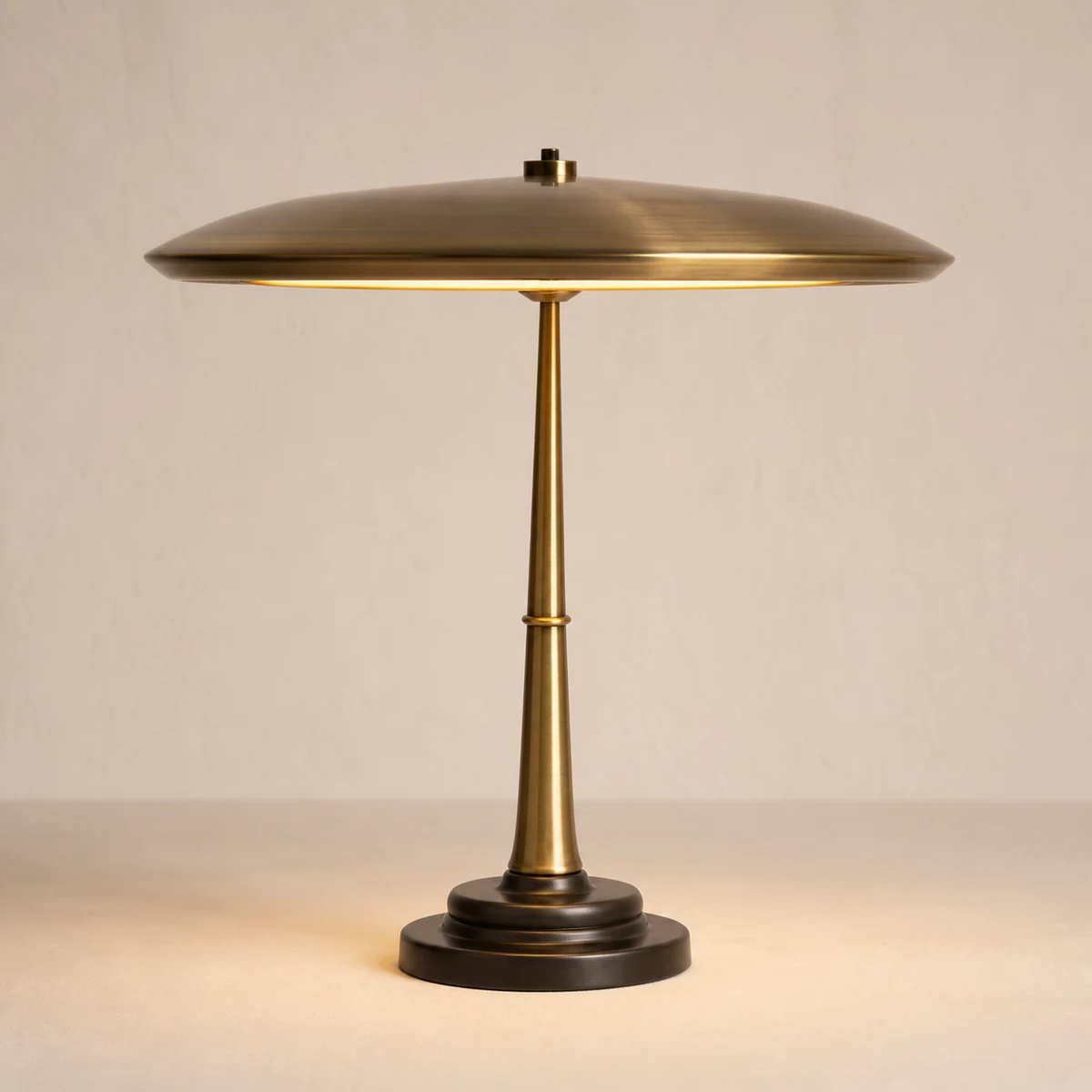
Halo Rib was drawn for that threshold. Its broad, shallow canopy holds light close to the surface below, while the narrow stem leaves the surrounding wall and objects visually calm. The lamp does not announce an occasion. It creates the composure from which an occasion can begin.
That is the deeper request behind this design: not more brightness, but a gentler transition. The first person the room welcomes is the person coming home.
Why the form feels different
The familiar dome is made more architectural by three decisions: a low horizontal profile, a long tapered stem, and a dark concentric base. The contrast gives the lamp a grounded silhouette without making it heavy.
A restrained brass finish carries warmth even when the lamp is off. Fine ribbing and stepped details are intended to reward a closer look rather than compete across the room. From a distance, the form is calm; nearby, it becomes tactile.
How to place it
Place Halo Rib on an entry console where the canopy can sit below eye level and create a soft landing point. It can also work on a hospitality reception credenza, a private-club sideboard, or between two lounge chairs where direct glare would interrupt conversation.
Keep the styling low and edited: one tray, a small artwork, or a stack of books is enough. The lamp gains authority from negative space. For specification, test the finish beside the actual wall color and timber sample; warm metals can read very differently under cool ambient light.
A buyer's guide to the first sample
For a private-label or project version, the visual priority is the relationship between canopy diameter, stem height, and base weight. The sample should be reviewed both switched off and illuminated. Confirm whether the intended setting calls for wired or rechargeable power, the dimming method, target market, plug or charging architecture, diffuser treatment, finish tolerance, and retail or project packaging.
The image communicates design intent, not a frozen technical specification. Dimensions, lumen output, color temperature, battery configuration, controls, compliance requirements, and packing must be agreed against the sample and destination market.
The promise is not that this concept is already resolved. The promise is that the reason for the design is clear enough to guide every decision that follows.
Questions buyers ask
Is Halo Rib shown as a finished production model?
No. It is a design concept and lifestyle visualization. Final engineering and commercial specifications are confirmed through sampling.
Where does this lamp work best?
Entry consoles, lounge sideboards, reception credenzas, and other surfaces where a low, glare-conscious pool of light is more useful than broad room lighting.
Can the finish be developed for a private-label collection?
Finish direction can be discussed, but color, texture, tolerance, and durability should be approved on physical finish samples.
What should a buyer send for a quotation?
Destination market, project type, quantity, required date, preferred finish, power architecture, control method, and packaging channel.
Continue the series with the previous design story or the next design story. Browse more DISLUNA buyer guides and design stories.
Develop this direction with DISLUNA
Share the destination market, project type, quantity, required date, preferred finish, wired or rechargeable direction, control method, and packaging channel. We will confirm the specification questions and a practical sampling route.